In Search of Lost Ramen
As a so-called “elder millennial”, I grew up being completely and utterly in love with the mall.
I mean, you kind of have to when you spend your adolescence watching those now-infamous episodes of Saved By The Bell and The OC, where our teenage heroes were locked in a mall overnight.
The mall, however, served a much deeper sociological purpose than 16-year-old-me realized: it was a Third Place, one where I could transition from the days of my care-free childhood, to my bumbling adolescence, and eventually to my emerging adulthood as an actual paying patron of those aforementioned retail shops and services.
Malls, once a central commercial hub, have been seeing a decline in popularity over the years, with once-behemoth department stores like Sears and The Bay seeing their inevitable end. But the mall isn’t quite dead and gone; Metro Vancouver is still home to hundreds of shopping centres, ranging from small community retail centres to major shopping districts.
So I decided to go to one of these malls and see if I could find what made the mall so special in the days of my youth.
I decided to search for some ramen.
The Mission (Should We Choose To Accept It)
Some time ago, a friend had recommended a great ramen spot called Ramen Taka, located at Aberdeen Centre in Richmond. But I didn’t want to just type out the name of the restaurant on my phone and waltz right over there.
No, I wanted to recreate the feelings of my youth as much as I could. So that meant no smartphones, and only relying on the actual signage that the mall provided on-site.
And who knows signage better than my friend, Genevieve Tyack of Community Studios? An industry expert in the art of wayfinding, she was the perfect companion to bring along on my analogue quest for noodles.
Out Of The Frying Pan, Into The Fire
How foolish could I have been to think that the conversation would only begin once we got into the mall itself? Because Genevieve pointed out something that I often just assume is a natural part of the built environment (an oxymoron, I suppose): the designated wheelchair accessibility parking spot.

The “typical” wheelchair symbol one might see depicts the wheelchair user in an “upright” position, whereas here, they depict somebody in motion.
“Is there maybe an ableism component to that?” questioned Genevieve.
“Potentially, although the newer icon hasn’t been formally recognized as the International Symbol of Access because signage also needs to be immediately recognizable for people with cognitive impairments. The modified symbol was only formally recognized as an interpretation in BC Building Code in 2022, and it sparked really interesting conversations around visibility and identity within the disability community.”
You Can Go Your Own Way
Blame it on Lord Of The Rings, but I’ve always loved a good ol’ fashioned map. A map represents the limitless possibilities of space while also containing them within something we can navigate.
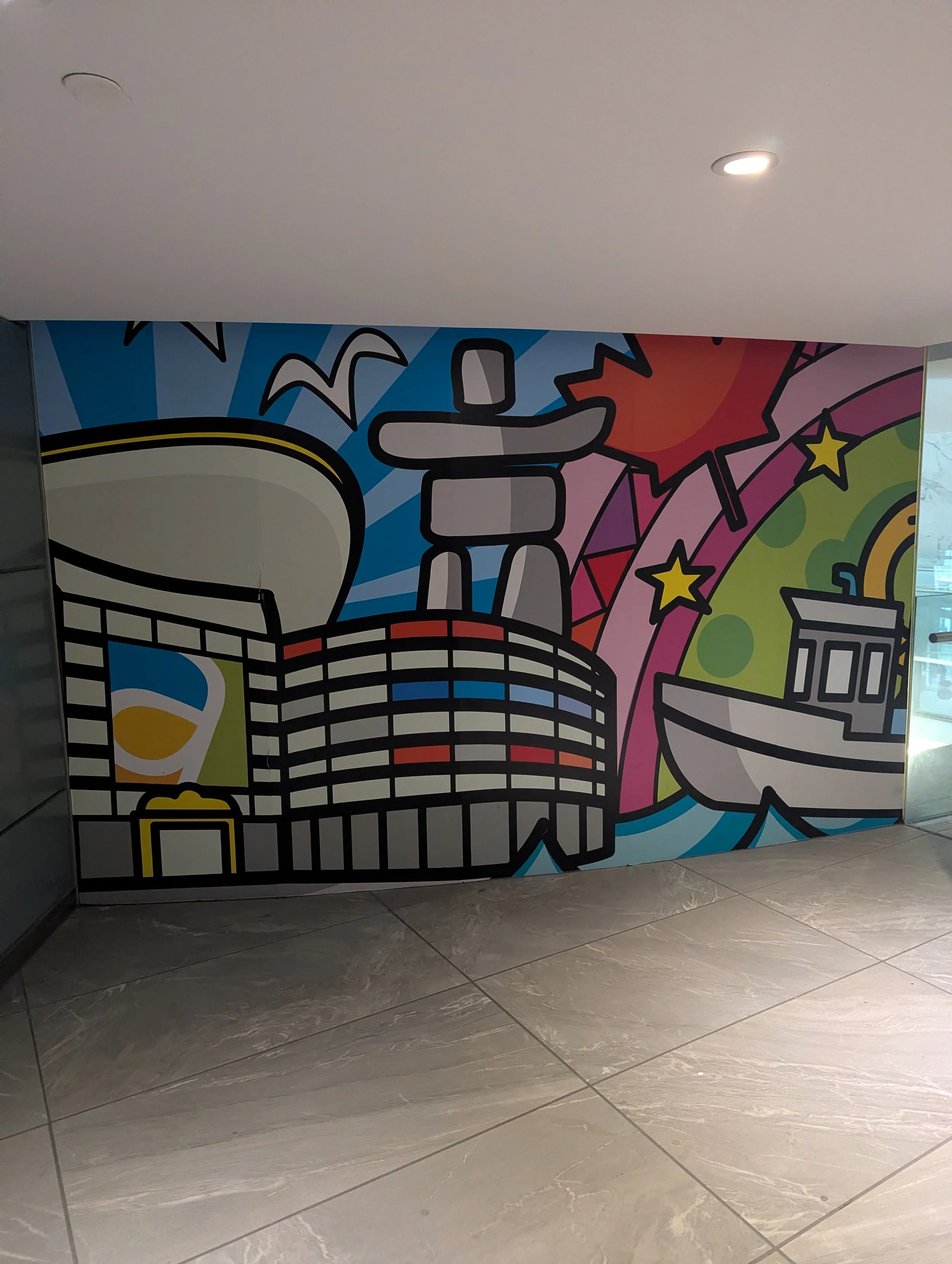
So our first step of action was to find a map of some kind, of course. Walking into the front entrance, we spotted a brightly coloured mural by the elevator.
“So it's not necessarily signage, but it functions as a landmark,” she commented.
“So if you're trying to get back and think ‘Oh, we're here, is this where I parked the car?’ You'd say ‘yeah, because I remember passing by that mural.’”
But hunger prevailed over art appreciation, so we continued on, as Genevieve shared more insights on wayfinding as a craft:
“There's some school of thought in wayfinding that if you have to put a sign in you failed,” she said. “It's a little bit reductionist becausewith a complex environment, like a mall or a hospital, you have to put signs in.”
There’s more to wayfinding than just the sign or map itself, I was learning.
“If you can do other subtle clues, like change the way the tiling is on the floor or use different materials or planter boxes, you can push people along without them realizing. And I think people feel really comfortable with that. When there's less choice and people can go back to their conversation, or back to whatever they're thinking about.”
By The Watering Hole
Ah, “decision fatigue… It feels like we have more choices than ever: but does more necessarily equal better? Humans can make up to 35,000 decisions a day, and lunch is just one of them.
“It used to be that malls would kind of try and trick you into staying longer,” Genevieve added.
“But now malls realize they've gone out of fashion because they're high stress, hard to park, big, and confusing. So it's an intentional choice to come to a mall.”
At this point, we reached what seems to be a staple in every mall that’s ever existed: the water fountain.
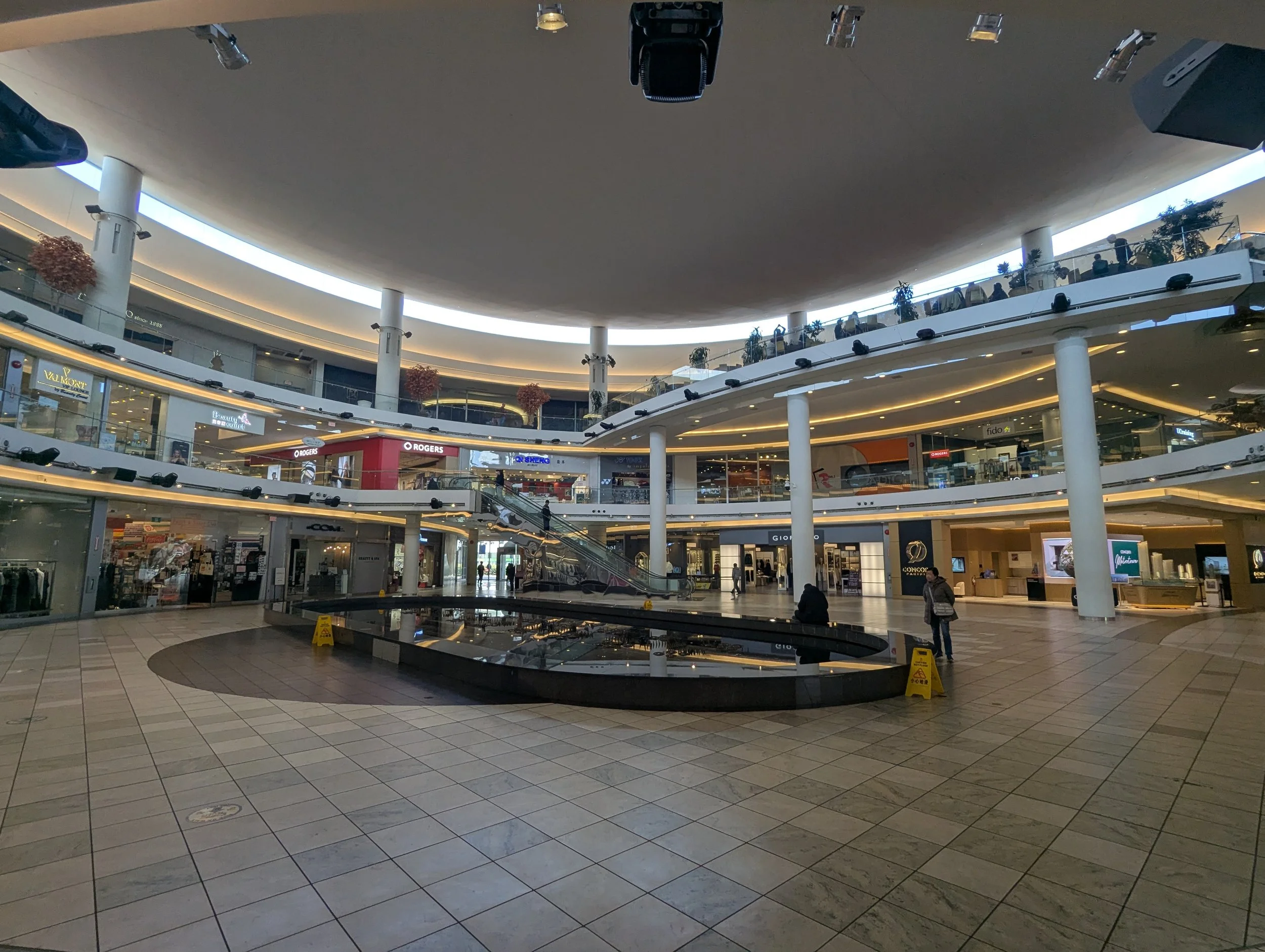
Cady Heron from Mean Girls was pretty much on the money: the water fountain is the mall’s central hub, the “watering hole” as she put it. I still remember the water fountain in Brentwood Mall in the 1990s, how I used to beg my mom for pennies that I could throw in. Not only does the water fountain serve as a wayfinding landmark, as Genevieve pointed out, it’s a respite in an otherwise bustling environment.
A place to rest your decision fatigue, perhaps.
A Sign Of The Times
We did eventually find our way to Ramen Taka; I ordered the Tsukemen, which was so, so delicious. As we were eating our lunch, Genevieve shared an anecdote with me:
“I was out one day and my phone wouldn't turn back on again, no matter what I did. So I tried to catch a bus, but you don't know when the bus is coming because they don't print a schedule anymore. And then I realized I couldn't get an Evo either because my Evo was attached to my phone. So I ended up calling an old school cab - it was like a ‘wave down on the side of the street’ scenario, which felt old school.”
Hailing down a cab. Spending an afternoon at the mall with a friend eating a bowl of ramen. Very old school, indeed.
In the end, finding the restaurant was actually fairly easy, as each floor at the mall had a digital map that was easily accessible and intuitive to use.

It used to feel like the “journey” belonged to us: that we were the protagonist, like Frodo Baggins on his way to Mordor. And technology may have taken some of that whimsy away from us.
But this was never about saying that the past was better than how things are now; after eating our lunch, I used Google Maps to drive Genevieve back home, after all. Getting to our destination still matters. But maybe getting a little lost along the way isn't so bad after all.